Today it is but a memory, but there was time it was grand. What was grand, you say? Why the Hastings Spiral Bridge, leaving Washington County at a steady incline to cross the Mississippi River before …
This item is available in full to subscribers.
To continue reading, you will need to either log in, using the login form, below, or purchase a new subscription.
If you are a current print subscriber, you can set up a free website account and connect your subscription to it by clicking here.
Otherwise, click here to view your options for subscribing.
Please log in to continue |
Today it is but a memory, but there was time it was grand. What was grand, you say?
Why the Hastings Spiral Bridge, leaving Washington County at a steady incline to cross the Mississippi River before debarking onto Second Street, bringing business straight into town. The Hastings Gazette of April 27, 1895 described the then new bridge heralding a “new epoch.”
“The completion of the new high wagon bridge across the Mississippi River is an epoch in the history of our city that deserves more than passing notice,” it said, “and it is eminently proper that the formal opening should be celebrated by a public demonstration befitting the occasion.” The drive to have a new bridge had started four years earlier with the agitation and persistent efforts of Alderman J. P. Sommers.
Following Sommer’s agitation, a bill was introduced by D.S. Hall and passed by Congress, authorizing construction of a bridge with its foot at Sibley Street. Along with the bill was a sum of $600 from the state legislature.
“This amount was so insignificant that it was later transferred to the bridge near Ennis Mill,” the Gazette wrote, sharing that the idea had slumbered as L. H. Johnson and Alderman N. L. Bailey looked over the grounds. New attempts were made, the question of issuing $40,000 in bonds to finance construction posed at the April election a year later and passing by a vote of 694 to 37. Bridge companies were invited over, with the contract awarded to the Wisconsin Bridge and Iron Company for $39,050. Rock came from Red Wing and work was commenced on Sept. 25, 1894, a crew of four men breaking stones and driving piles into the riverbed.
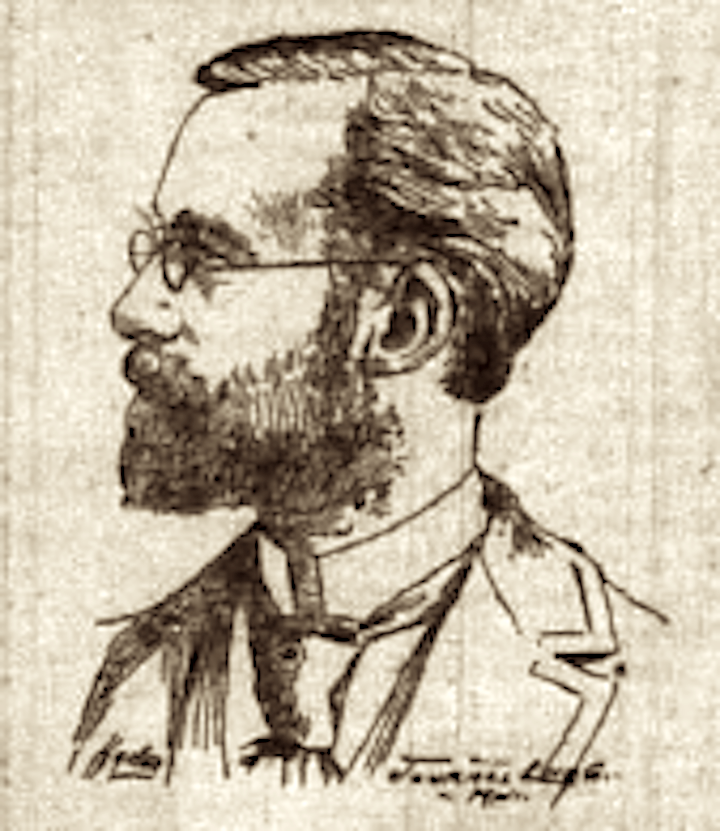
“The bridge is the only one of its kind in America and probably the world,” the Gazette shared, with management level contributors including F. and B. Weinhagen, principal owners and promoters of the Wisconsin Bridge and Iron Company. Also important to bridge construction were J. F. Jackson, general erection superintendent of the Wisconsin Bridge and Iron Company, chief engineer John Geist, L. H. Johnson, general northwestern agenda for the Wisconsin Bridge and Iron Company, and Oscar Claussen, supervising engineer of the project. The Wienhagens were both born in Germany, while Jackson had been born at Hicksville in Defiance County, Ohio, Johnson Geist at Bergen, Norway, Johnson at Schlesvig, North Germany, and Clausen at Terre Haute, Indiana on Dec. 26, 1860.
Details of the bridge completion were shared in the April 20, 1895 Gazette.
The Bridge completed
“The last plank in the new wagon bridge was laid Wednesday afternoon at three o’clock, and two hacks containing Mayor Heinen, Alds. Austin, Bailey, Gergen, Mather, Sommers and Tuttle, William Hodgson, acting city attorney, and Irving Todd Jr., city clerk, were driven over by way of an informal opening,” it stated, saying that a bowl of champagne punch and cigars were sampled “in honor of the occasion.” A more formal opening was being scheduled for Saturday, April 27, the bridge having opened for travel on the Thursday following completion. Served by a long approach on the Washington County side with a large central span that ran across the Mississippi north and south, the bridge used a spiral to bring traffic direct into downtown rather than extending past it to mirror the Washington County side.
“The bridge proper is known as the Baltimore truss, curved top cord” the Gazette related on the day of formal dedication. Built throughout in what was deemed “a very substantial manner,” the substructure contained 1,000 cubic yards of stone masonry, 20,000 feet of timber, one hundred and eighty cubic yards of concrete, 2,500 hundred yards of earth fill, and 2,400 of lineal feet filing. The superstructure contained 500 tons of steel and 150,000 feet of lumber for the floor. Special attention was given to the construction of the floor of the large central span “to obviate vibration,” with the Gazette declaring that the builders had been “very successful” on this point.
In years to come controversy would erupt as to just who had been individually responsible for the unique design, per the Dakota County Historical Society. Among names floated in the controversy were Oscar Claussen, John Geist, Hastings businessman John Melow, B.D. Caldwell, and former Minnesota House speaker Lawrence H. Johnson, with Johnson claiming it was based on a design by Horace Horton of the Chicago Bridge and Iron Company meant for Winona.
Of the contenders for individual bridge inspiration Geist, Claussen, and Johnson appear on the front page of the Gazette issue announcing its opening.
But as with all good things come to an end, the days of the Hastings Spiral Bridge were numbered. The work of the elements and time led to safety concerns. In the spring of 1946 the bridge’s weight limit was reduced to four tons, following years of decay and a letter by Minnesota Department of Highways Bridge Engineer E. J. Miller to the city.
“The ‘Spiral Bridge’ at Hastings has been a matter of concern to all of us for quite some time,” Miler wrote Mayor Edith Truax. “It has gradually been deteriorating with age, so that corrosion of steel and decay of timber are of serious concern. The bridge is now posted for six tons gross load and we are today arranging to further reduce the restriction down to four tons, so as to adequately safeguard life and property.”
Calling on the city of Hastings to vigorously enforce the weight limits to avoid “serious catastrophe” and bridge failure, Miller signed the letter “Very Truly Yours.”
Following the letter’s arrival in spring 1946, the Hastings Gazette ran a poll in which the vote came out 500 to 10 to support a new bridge immediately at Hastings, disembarking onto Vermillion. The spiral bridge’s ultimate end came in 1951, following an unsuccessful resolution for the Dakota County Historical Society to take title and preserve the bridge, following a lobby effort by business owners to the governor.
Spanning from horse and buggy days into the automobile age, the Hastings Spiral Bridge lives today only in memory, but for a time, it was grand. For those wishing to see it still, a scale model is kept in the Hastings Pioneer Room at City Hall.